
Reverse Osmosis Plants
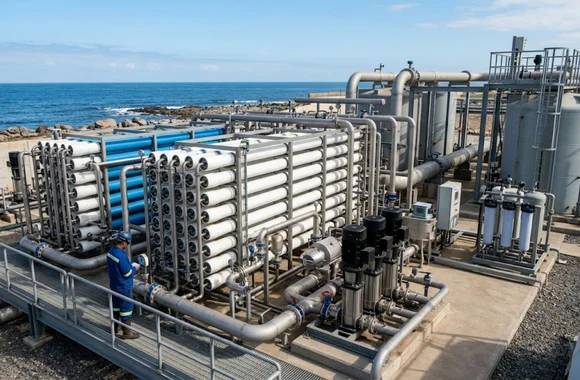
We present a premium range of RO Plants widely used for delivering high-quality drinking water solutions across various industrial applications. These systems are engineered using high-quality components and advanced technology by our expert team at Jalnova. Our RO plants are available in different sizes and configurations to meet diverse client requirements. Furthermore, we ensure these systems are offered at cost-effective prices.
Reverse Osmosis Working Principle
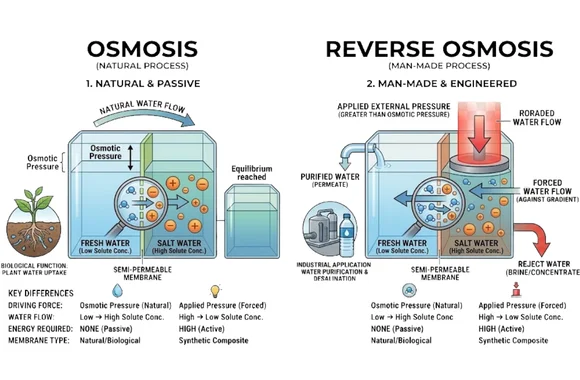
Reverse Osmosis operates using a semi-permeable RO membrane, which functions as a physical filtration barrier. Pressure greater than osmotic pressure is applied on one side of the solution, forcing water molecules to pass through the membrane while rejecting impurities. Contaminants such as dissolved salts are retained and removed for further processing.
During this process, two outputs are generated: permeate (purified water) and reject water (concentrated impurities). Reverse Osmosis works by allowing the solvent to pass through the membrane against the concentration gradient, moving from a lower concentration to a higher concentration side.
What is Reverse Osmosis?
Reverse Osmosis is an advanced membrane filtration technology used for removing dissolved solids and impurities from water. It is widely applied in drinking water purification by eliminating salts, minerals, and other harmful contaminants. Today, this technology is extensively used in industrial, commercial, and residential water treatment applications.
Stages in Reverse Osmosis
Pre Filtration:
The pre-filtration stage consists of two important processes:
Sediment Filter:
This filter removes physical impurities such as dust, rust, suspended particles, and other solid contaminants present in water.
Carbon Filter:
The carbon filter eliminates chlorine, volatile organic compounds (VOCs), and unwanted odors, improving water quality before it enters the RO membrane system.
Reverse Osmosis Membrane
The performance of an RO system is primarily dependent on its membrane structure. Each membrane consists of a spiral-wound sheet made of semi-permeable material, selected based on application requirements. RO membranes are available in 2-inch, 4-inch, and 8-inch diameters, with 4-inch and 8-inch variants being most widely used in industrial water treatment systems.
Applications
- Food and Beverage Industry: Provides purified water for processing and production
- Dairy Industry: Used in milk processing and dairy product manufacturing
- Paper and Pulp Industry: Supports water purification in production processes
- Textile Industry: Essential for dyeing, washing, and processing operations
- Printing and Coating Industry: Ensures high-quality water for coating and finishing applications
- Surfactant Industry: Used in chemical formulation and manufacturing processes